
 Ελληνικά

The photo may not represent 100% of the product features.
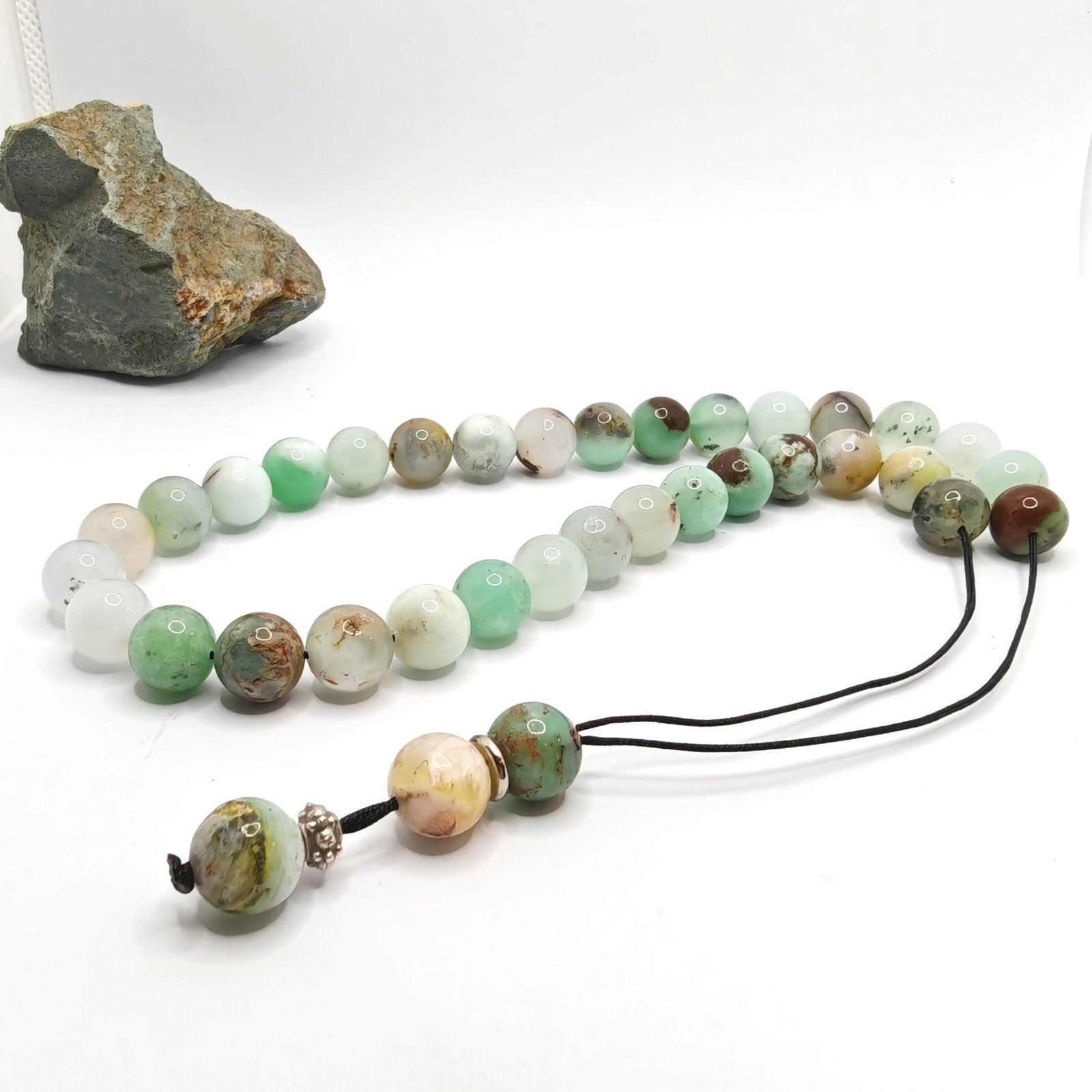
Chrysoprase Komboloi AC0172
Worry beads made from chrysoprase, consisting of 33 beads with a diameter of Ø10 mm, strung on a paracord cord.
Total length: 29 cm | Weight: 49 g
Presented with a certificate of authenticity
95,00 €
In stock
The mineral chrysoprase (from the Greek word chrysoprasus, through Latin) is a variety of chalcedony with a green color reminiscent of leek, grapes, or apple, depending on the deposit. This color is due to its nickel content as well as the way it forms geologically.
Notable sources of chrysoprase include Australia, the United States, Russia, Poland, Madagascar, and Germany.
It is a cryptocrystalline mineral, meaning its crystals are so small that they cannot be distinguished with simple magnification. This characteristic distinguishes it from crystalline stones such as amethyst and others, which are almost transparent and form clear hexagonal crystals.
What primarily attracts attention in chrysoprase is its distinctive color rather than its crystal formations. Its hardness ranges from 6 to 7 on the Mohs scale.
Note: Inclusions, cracks, and fracture surfaces are natural characteristics of this particular gemstone. They are entirely natural and attest to the authenticity of the material.
| Ημιπολύτιμες πέτρες | Chrysoprase |
|---|
All texts, product descriptions, and photographs are the intellectual property of KAHRAMAN. Any reproduction, distribution, or use, in whole or in part, without prior written permission is strictly prohibited. All rights reserved.
Related products
49,00 €

35,00 €
58,00 €
60,00 €
190,00 €

55,00 €
100,00 €
30,00 €
The mineral chrysoprase (from the Greek word chrysoprasus, through Latin) is a variety of chalcedony with a green color reminiscent of leek, grapes, or apple, depending on the deposit. This color is due to its nickel content as well as the way it forms geologically.
Notable sources of chrysoprase include Australia, the United States, Russia, Poland, Madagascar, and Germany.
It is a cryptocrystalline mineral, meaning its crystals are so small that they cannot be distinguished with simple magnification. This characteristic distinguishes it from crystalline stones such as amethyst and others, which are almost transparent and form clear hexagonal crystals.
What primarily attracts attention in chrysoprase is its distinctive color rather than its crystal formations. Its hardness ranges from 6 to 7 on the Mohs scale.
Note: Inclusions, cracks, and fracture surfaces are natural characteristics of this particular gemstone. They are entirely natural and attest to the authenticity of the material.
| Ημιπολύτιμες πέτρες | Chrysoprase |
|---|