
 Ελληνικά

The photo may not represent 100% of the product features.

Mineral Opal Pendant BE0347.
Opal pendant set in 925 sterling silver.
Stone dimensions: 33 mm x 26 mm.
Includes a certificate of authenticity.
The photo may not fully represent the product’s features.
Inclusions, fractures, and surface cracks are natural features and should not be considered as damage.
(Chain not included.)
85,00 €
In stock
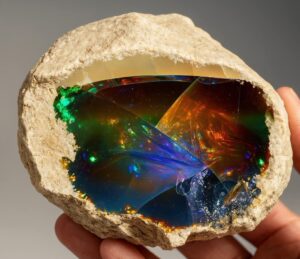
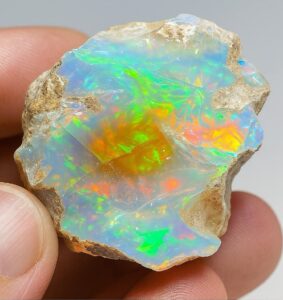
Opal – Natural mineral.
Opal is a precious, amorphous, hydrated silicate mineral (SiO₂·nH₂O), composed of silicon dioxide with varying amounts of water (up to 20%). Unlike quartz, it has no crystalline structure; instead, it consists of microscopic silica spheres that diffract light, creating the phenomenon of opalescence — the famous play of color that makes opal appear to “dance” with light.
Main varieties
Precious Opal: the valuable variety displaying iridescence across the full spectrum of colors.
Common Opal: the non-precious variety, lacking a strong play of color, often found in shades of white, pink, blue, or green.
Fire Opal: a transparent or translucent variety with a vivid orange-red hue, rich in energy and vitality.
Properties and symbolism
A gemstone associate with inspiration, purity, and inner light.
Believed to enhances creativity, intuition, and emotional expression.
Traditional linked to emotional truth and emotional purification.
In ancient times, it was said to contain the magic of all gemstones, as it reflects every color.
Spiritually, it is regarded as a stone of transition and renewal, opening the mind to the Divine light.
Geological origin
Opal forms from a silica solution in water that seeps into rock crevices; as the water evaporates, microscopic spheres of silicon dioxide are left behind.
Main sources: Australia (the world’s largest producer), Ethiopia, Mexico, Honduras, and Czech Republic.
| Material | 925 Silver, Precious/Semi-Precious Stones |
|---|
All texts, product descriptions, and photographs are the intellectual property of KAHRAMAN. Any reproduction, distribution, or use, in whole or in part, without prior written permission is strictly prohibited. All rights reserved.
Related products

139,00 €
25,00 €
119,00 €
1.150,00 €
59,00 €
160,00 €
Opal – Natural mineral.
Opal is a precious, amorphous, hydrated silicate mineral (SiO₂·nH₂O), composed of silicon dioxide with varying amounts of water (up to 20%). Unlike quartz, it has no crystalline structure; instead, it consists of microscopic silica spheres that diffract light, creating the phenomenon of opalescence — the famous play of color that makes opal appear to “dance” with light.
Main varieties
Precious Opal: the valuable variety displaying iridescence across the full spectrum of colors.
Common Opal: the non-precious variety, lacking a strong play of color, often found in shades of white, pink, blue, or green.
Fire Opal: a transparent or translucent variety with a vivid orange-red hue, rich in energy and vitality.
Properties and symbolism
A gemstone associate with inspiration, purity, and inner light.
Believed to enhances creativity, intuition, and emotional expression.
Traditional linked to emotional truth and emotional purification.
In ancient times, it was said to contain the magic of all gemstones, as it reflects every color.
Spiritually, it is regarded as a stone of transition and renewal, opening the mind to the Divine light.
Geological origin
Opal forms from a silica solution in water that seeps into rock crevices; as the water evaporates, microscopic spheres of silicon dioxide are left behind.
Main sources: Australia (the world’s largest producer), Ethiopia, Mexico, Honduras, and Czech Republic.
| Material | 925 Silver, Precious/Semi-Precious Stones |
|---|