
 Ελληνικά

The photo may not represent 100% of the product features.
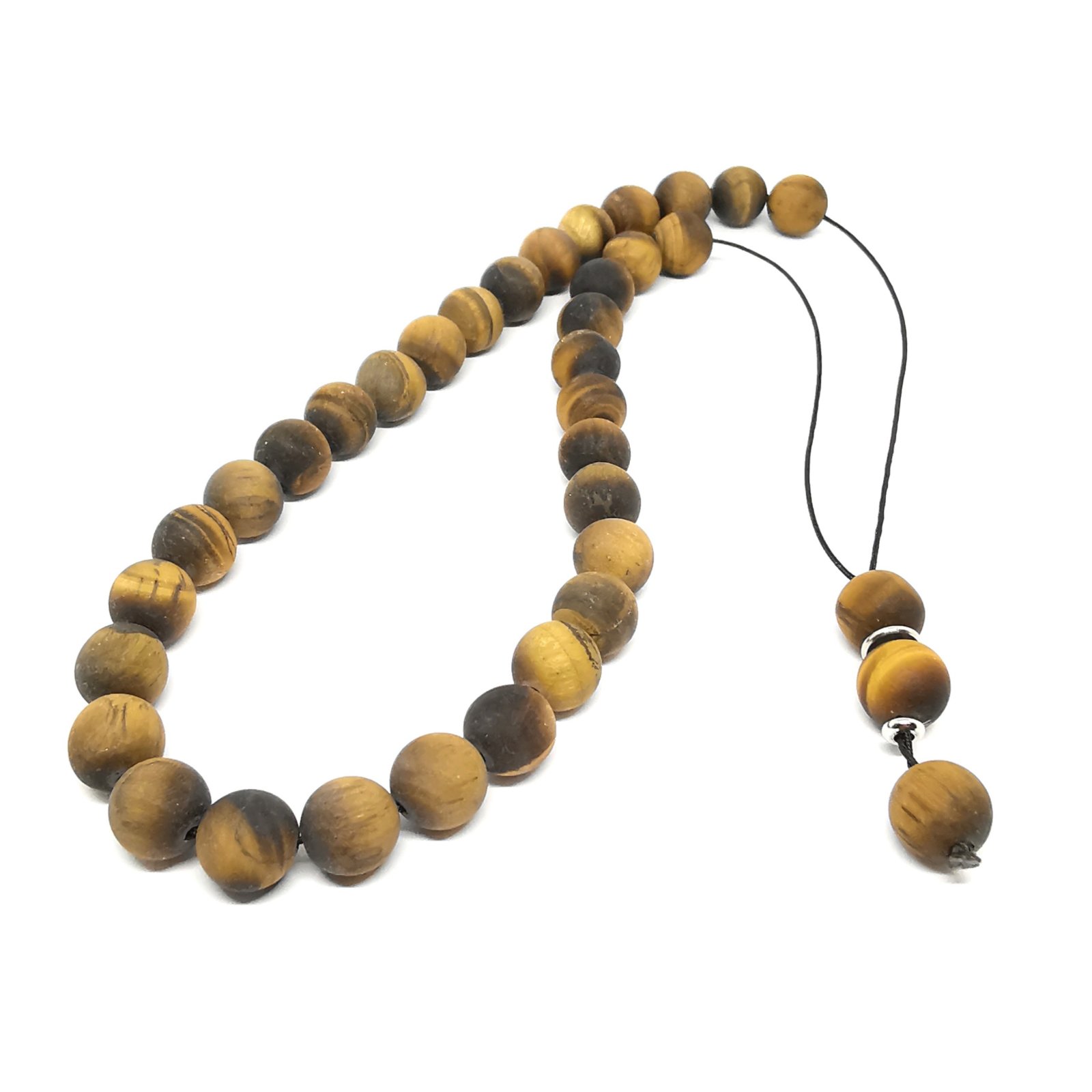
Tiger’s Eye Komboloi AC0263
Tiger’s eye komboloi made of 33 round-shaped beads each 10 mm in diameter, threaded on a nylon cord.
Total length: 29 cm | Weight: ±56 g
Includes a certificate of authenticity.
38,00 €
In stock
Tiger’s eye is a semi-transparent variety of quartz with a characteristic golden-yellow to brown color. It is distinguished by its unique optical effect, a distinctive linear iridescence that resembles a moving sheen across its surface. These bands, in shades of gold and brown, are due to the fibrous structure of crocidolite contained within the material. This striking phenomenon is known by the French term chatoyancy, translated into Greek as “cat’s eye.” Deposits of tiger’s eye are found in regions such as the USA, South Africa, Namibia, and Brazil.
Traditionally, tiger’s eye is associated with stability and grounding, offering a sense of balance and practical thinking. It is believed to enhance self-confidence and concentration, supporting clearer decision-making. At the same time, it is attributed a protective quality, as it is thought to act as a “shield” against negative influences and external pressures.
Additionally, it is said to help reduce tension and support emotional balance in everyday life. Its warm appearance and distinctive luster make it especially appreciated, both for its aesthetic appeal and the symbolism associated with it.
Note: The properties attributed to tiger’s eye are based on tradition and empirical use and do not constitute scientifically established therapeutic claims. Careful use of the komboloi is recommended. Natural lines, pores, or subtle surface irregularities are inherent characteristics of the material and highlight its authenticity. The cord wears naturally with use, especially in products made from stone or heavier materials. This wear does not constitute a defect and can be easily restored through replacement.
| Ημιπολύτιμες πέτρες | Tiger's Eye |
|---|
All texts, product descriptions, and photographs are the intellectual property of KAHRAMAN. Any reproduction, distribution, or use, in whole or in part, without prior written permission is strictly prohibited. All rights reserved.
Related products

45,00 €

38,00 €
59,00 €

28,00 €

250,00 €
190,00 €
35,00 €

145,00 €
Tiger’s eye is a semi-transparent variety of quartz with a characteristic golden-yellow to brown color. It is distinguished by its unique optical effect, a distinctive linear iridescence that resembles a moving sheen across its surface. These bands, in shades of gold and brown, are due to the fibrous structure of crocidolite contained within the material. This striking phenomenon is known by the French term chatoyancy, translated into Greek as “cat’s eye.” Deposits of tiger’s eye are found in regions such as the USA, South Africa, Namibia, and Brazil.
Traditionally, tiger’s eye is associated with stability and grounding, offering a sense of balance and practical thinking. It is believed to enhance self-confidence and concentration, supporting clearer decision-making. At the same time, it is attributed a protective quality, as it is thought to act as a “shield” against negative influences and external pressures.
Additionally, it is said to help reduce tension and support emotional balance in everyday life. Its warm appearance and distinctive luster make it especially appreciated, both for its aesthetic appeal and the symbolism associated with it.
Note: The properties attributed to tiger’s eye are based on tradition and empirical use and do not constitute scientifically established therapeutic claims. Careful use of the komboloi is recommended. Natural lines, pores, or subtle surface irregularities are inherent characteristics of the material and highlight its authenticity. The cord wears naturally with use, especially in products made from stone or heavier materials. This wear does not constitute a defect and can be easily restored through replacement.
| Ημιπολύτιμες πέτρες | Tiger's Eye |
|---|