
 Ελληνικά

The photo may not represent 100% of the product features.
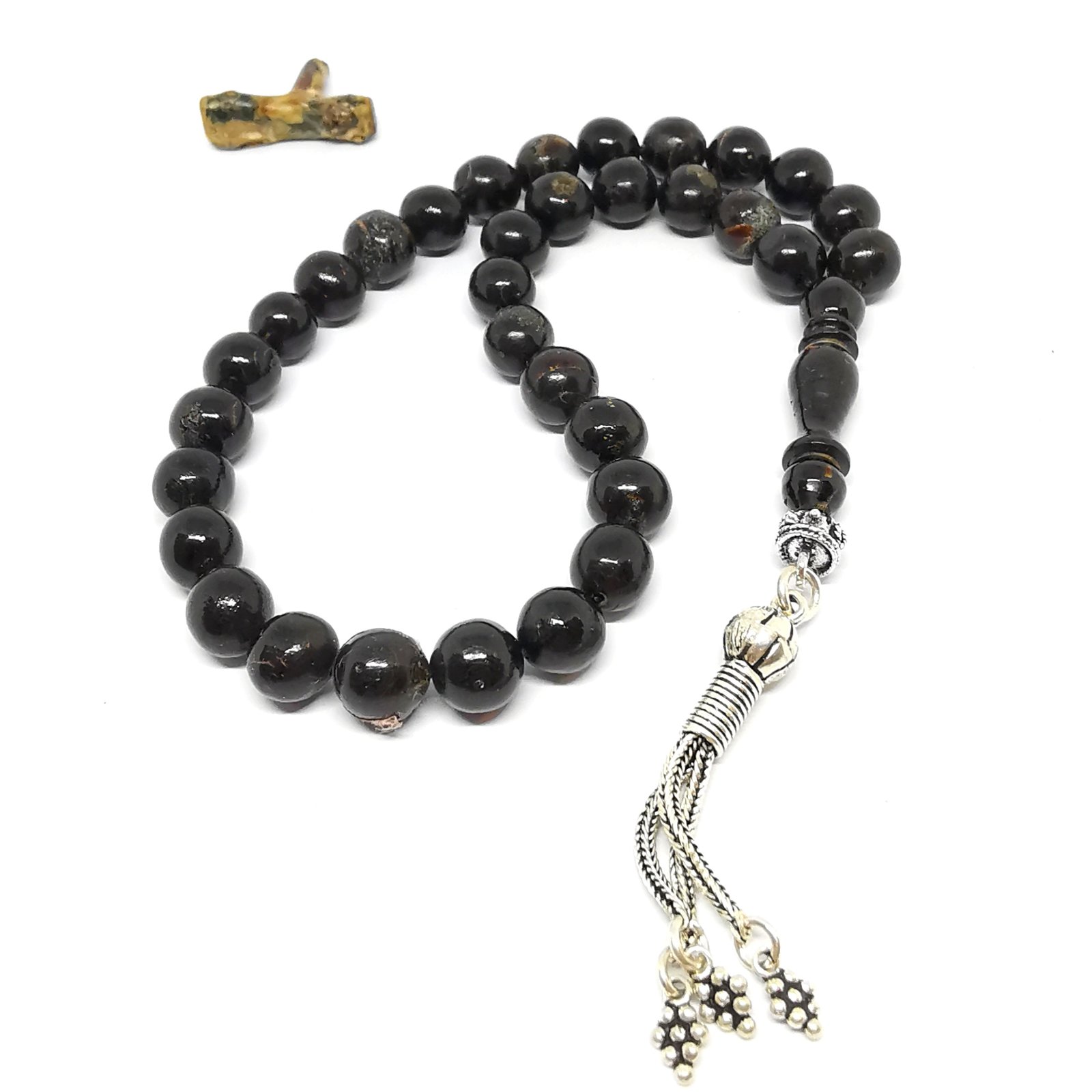
Yusuri Prayer Beads AI0029
Yusuri prayer beads made of 33 round-shaped black coral beads with sterling silver tassel.
Total length: 18 cm | Weight: 21 g
Presented with a certificate of authenticity
155,00 €
In stock
Coral is the skeleton of many small marine organisms that comprise a colony. These organisms are polyps, each a few millimeters in size. When a new polyp is born, it attaches its skeleton to the colony and thus expands it. In coral colonies, along with the polyps, some single-celled algae coexist, which photosynthesize and supply food to the polyps, and at the same time secrete pigments that color the colonies, i.e. the corals. Corals can appear in a wide variety of colors such as pink-red, beige, white, as well as black (Yusuri coral). It is believed to remove all negativity and enhance sexuality.
Note: Black Coral (Yusuri) is a natural organic material of marine origin, formed through the growth of a sea organism. It features a porous organic structure with natural grain, markings, and minor imperfections, and does not possess the hardness of metals or hard minerals. Its surface sheen results from aesthetic finishing processes, without altering its natural composition.
Over time and through regular use, it is natural for the material to show a reduction in luster, minor wear, surface flaking in areas of friction, or subtle texture changes. These characteristics are considered part of the material’s natural evolution and not a manufacturing defect.
Coral may also be affected by friction, pressure or impact, moisture and perspiration, alcohol-based or chemical cleaning agents, and prolonged mechanical stress in general.
These properties are documented by internationally recognized sources such as the Gemological Institute of America (GIA), the Smithsonian National Museum of Natural History, and CIBJO (World Jewellery Confederation), all of which recognize coral as an organic gem material with natural sensitivity and surface variation over time and use.
| Ημιπολύτιμες πέτρες | Coral, Yusuri |
|---|---|
| Prayer\'s Beads | Orthodox |
All texts, product descriptions, and photographs are the intellectual property of KAHRAMAN. Any reproduction, distribution, or use, in whole or in part, without prior written permission is strictly prohibited. All rights reserved.
Related products
155,00 €
68,00 €
470,00 €

35,00 €
40,00 €

890,00 €
125,00 €
58,00 €
Coral is the skeleton of many small marine organisms that comprise a colony. These organisms are polyps, each a few millimeters in size. When a new polyp is born, it attaches its skeleton to the colony and thus expands it. In coral colonies, along with the polyps, some single-celled algae coexist, which photosynthesize and supply food to the polyps, and at the same time secrete pigments that color the colonies, i.e. the corals. Corals can appear in a wide variety of colors such as pink-red, beige, white, as well as black (Yusuri coral). It is believed to remove all negativity and enhance sexuality.
Note: Black Coral (Yusuri) is a natural organic material of marine origin, formed through the growth of a sea organism. It features a porous organic structure with natural grain, markings, and minor imperfections, and does not possess the hardness of metals or hard minerals. Its surface sheen results from aesthetic finishing processes, without altering its natural composition.
Over time and through regular use, it is natural for the material to show a reduction in luster, minor wear, surface flaking in areas of friction, or subtle texture changes. These characteristics are considered part of the material’s natural evolution and not a manufacturing defect.
Coral may also be affected by friction, pressure or impact, moisture and perspiration, alcohol-based or chemical cleaning agents, and prolonged mechanical stress in general.
These properties are documented by internationally recognized sources such as the Gemological Institute of America (GIA), the Smithsonian National Museum of Natural History, and CIBJO (World Jewellery Confederation), all of which recognize coral as an organic gem material with natural sensitivity and surface variation over time and use.
| Ημιπολύτιμες πέτρες | Coral, Yusuri |
|---|---|
| Prayer\'s Beads | Orthodox |